Too Many Servers, Not Enough Community: How Fandom's Digital Explosion Left Us All Feeling Alone

There's a strange kind of loneliness that hits when you're sitting in five different Discord servers, watching a Reddit thread explode with hot takes, and scrolling through a TikTok For You page that's somehow perfectly tuned to your niche interests — and still feeling like nobody actually gets you.
That's the paradox eating at the heart of sci-fi fandom right now. We have more ways to connect than ever before. More platforms, more communities, more corners of the internet dedicated to the exact franchises we love. And yet, talk to fans at conventions, in comment sections, or just among friends, and you keep hearing the same thing: it doesn't feel like enough. It doesn't feel real.
So what happened?
The Fragmentation Nobody Asked For
Cast your mind back to the early days of online fandom — the mid-2000s forum era, when a single message board might host every conversation worth having about a show or franchise. You knew the regulars. You had inside jokes with people whose usernames you recognized on sight. There was a shared culture, even if it came with its own drama and yes, its own gatekeeping.
Fast forward to today, and that single town square has been replaced by approximately ten thousand separate rooms, each one dedicated to a slightly different sliver of the same fandom. There's a Discord server for the original trilogy purists, another one for the expanded universe crowd, a subreddit for the show's cinematography, a TikTok community that communicates entirely in reaction clips, and a streaming platform forum that only the people who subscribe to that specific service ever see.
Every one of those spaces is technically a community. But they don't talk to each other. They barely know the others exist.
Dr. Christine Sanz, a media studies researcher who studies online fan behavior, described the phenomenon in a 2023 interview as "community splintering" — where the sheer abundance of options causes fans to self-sort into increasingly narrow micro-groups, losing the cross-pollination that made older fandom feel so alive. You stop encountering people who love the same thing differently than you do. Your feed just keeps showing you more of what you already think.
The Algorithm Is Not Your Friend
Here's where it gets uncomfortable: the platforms profiting from fandom's growth have a direct financial interest in keeping you engaged, not connected. Engagement and connection are not the same thing.
TikTok's algorithm is extraordinarily good at figuring out what kind of sci-fi content makes you stop scrolling. But it's optimizing for your attention, not for your relationships. It will serve you a hundred clips from fans who share your exact opinions, and it will quietly bury the voices that might challenge, expand, or just surprise you. The result is a fandom experience that feels personalized but is actually profoundly isolating — you're watching content about community while sitting alone.
Reddit operates differently but produces similar effects. Subreddits fracture into sub-subreddits. Moderators enforce increasingly specific community norms. Upvote mechanics reward the safest, most agreeable takes. The weird, passionate, slightly-unhinged energy that made early fandom forums so magnetic gets smoothed out by systems designed to reduce friction.
Discord is arguably the most intimate of the major platforms, but it comes with its own trap: discovery is nearly impossible. Unless you already know a server exists and have a direct invite link, you're not finding it. So instead of one big messy community, you get dozens of smaller ones that never intersect, each developing its own culture in isolation.
The Psychological Weight of Invisible Fandom
This isn't just an abstract structural problem. It has real effects on real people.
Fans — especially younger ones — are reporting higher rates of what some researchers are calling "fandom loneliness": the specific feeling of being deeply invested in something and having nobody in your immediate life who shares that investment. You're surrounded by online spaces supposedly built for people like you, but the connections never quite solidify into anything that feels like friendship.
Part of this is the nature of asynchronous communication. You post something in a server at 11pm. Three people react with emojis. Someone replies six hours later. The conversational thread is broken before it starts. Compare that to sitting in a hotel lobby at a convention at midnight, talking to a stranger about your favorite obscure sci-fi novel for two hours straight. One of those experiences builds something. The other one just fills time.
There's also the performance pressure that social media bakes into fan expression. On TikTok or Twitter, your fandom becomes content. Your opinions are posts. Your enthusiasm is a metric. That shift — from genuine expression to audience-aware performance — quietly drains the authenticity out of what used to feel like a safe space for nerdy passion.
Conventions as the Last Analog Refuge
Here's the thing that keeps coming up when you talk to fans who feel disconnected from online spaces: they almost universally describe conventions as the antidote.
Not the massive, commercially overwhelming ones necessarily — though those have their place — but any convention where you're physically present with other fans. Where you can read someone's body language when they talk about a film's third act. Where you can spontaneously join a conversation because you overheard someone mention a show you love. Where serendipity is still possible.
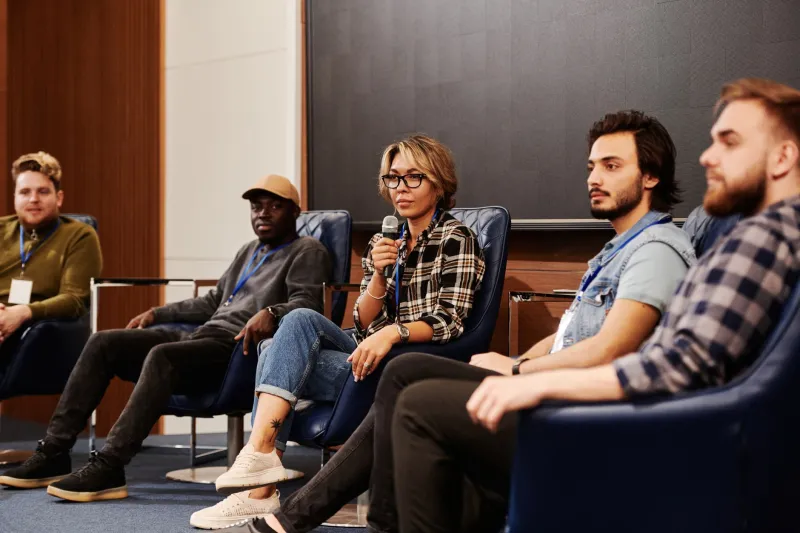
Conventions are immune to algorithmic curation. Nobody is sorting you into a filter bubble based on your engagement history. You might end up in a panel discussion next to someone whose taste in sci-fi is completely different from yours, and you might walk away with a new favorite series you never would have encountered online, because your feed never would have shown it to you.
That's not nostalgia talking. That's a genuine structural advantage that physical gathering has over digital connection — and it's one reason attendance at regional and mid-size conventions has remained stubbornly strong even as online fandom has exploded.
Finding Your People in a Fragmented Universe
None of this means you should delete your Discord accounts or rage-quit your favorite subreddit. Online spaces can be genuinely valuable, especially for fans in geographic areas where finding like-minded people in person is legitimately difficult.
But it's worth being intentional about how you use them. Seek out spaces that encourage disagreement and variety, not just validation. Follow creators and fans whose opinions push back against yours occasionally. And when a convention comes within reasonable distance — even a small one, especially a small one — go. Show up. Talk to strangers about the things you love.
Fandom was always at its best when it was a little chaotic, a little unpredictable, and full of people you didn't expect to meet. The algorithm can't give you that. Only showing up can.